identifAI has been recognised as a pioneer of real-time content validation by Gartner.
Read More >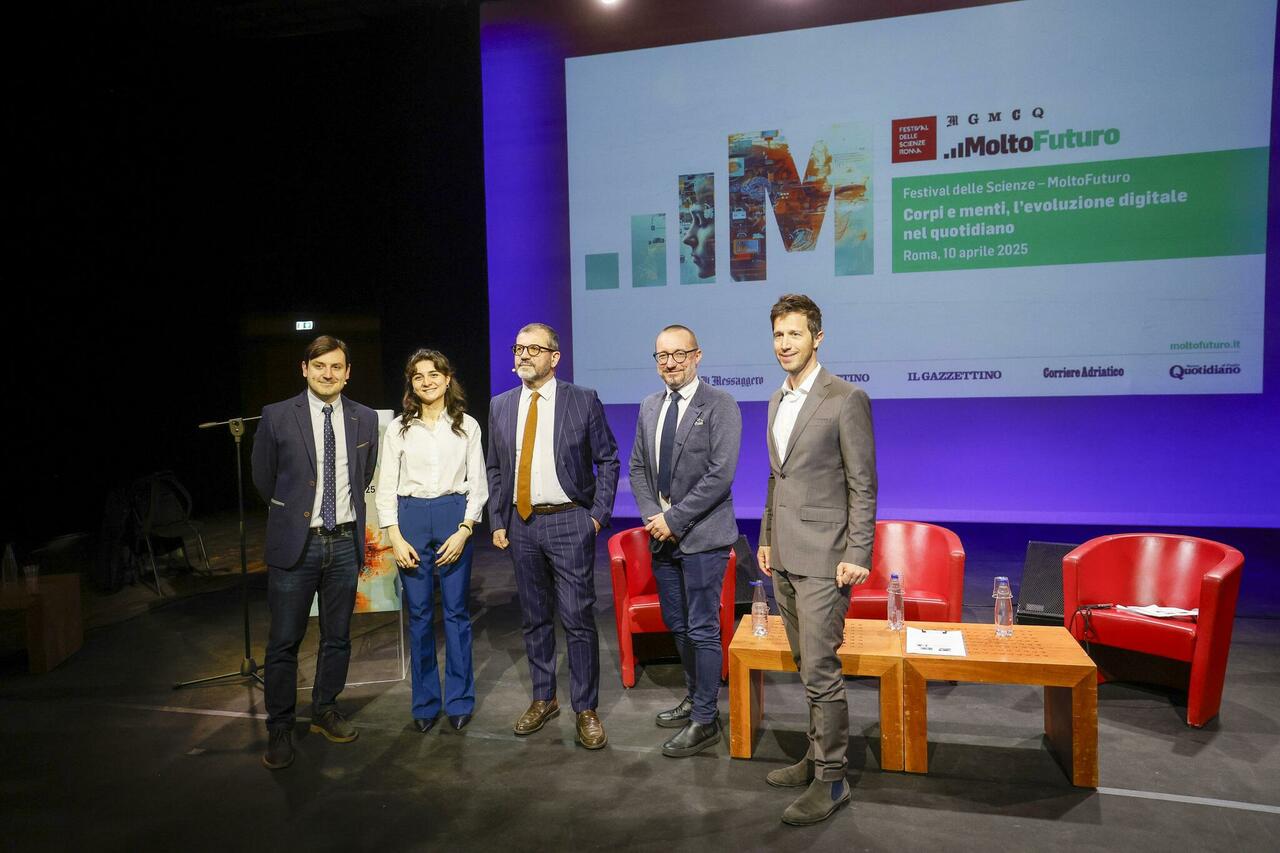
Artificial intelligence is changing the world as we know it. It is also transforming the way we think, and the way we approach both practical and theoretical problems. In short, as human beings, we will adapt once again. These ongoing transformations were discussed at the event Bodies and Minds: Digital Evolution in Everyday Life, organized by Molto Futuro as part of the Science Festival at the Auditorium Parco della Musica in Rome (running until April 13).
On stage, three AI experts engaged in conversation with Alvaro Moretti, Deputy Director of Il Messaggero, and journalist Andrea Andrei. In the audience sat a large number of high school students. And rightly so, because artificial intelligence is not only the present, but also very much the future.
“We are only now beginning to understand that daily interaction with the digital world has not only altered timeframes, but is also reshaping our minds,” emphasized Moretti, introducing the first guest, Fabrizio Piras, psychologist and clinical neuroscience expert at Fondazione Santa Lucia IRCCS.
“These technologies are relatively recent, about 20 years old, which is not a long span of time for research to fully assess their effects. Our brain has evolved over millennia precisely thanks to technology, though today we are witnessing an extremely rapid change,” explained Piras. He highlighted the importance of technological evolution in his own work, ranging from robots that support patients with motor impairments to brain–machine interfaces that allow movement of limbs through thought.
Recent studies suggest that social media use has reduced young people’s attention span. Technology both gives and takes away at the same time. It is already becoming difficult to distinguish truth from plausibility. This brings us to the issue of deepfakes. “These are AI algorithms that capture the features of a human face and make them appear as another person,” explained the second guest, Marco Ramilli, founder of IdentifAI, a company specializing in identifying the origin of digital content.
“Today, knowing who is really on the other side is no longer guaranteed. We have developed tools to determine whether what we see is authentic. Thanks to generative models, we can start from an image, a video, or a text and trace it back to its origin, to establish whether it was generated by a human mind or an artificial one,” Ramilli told an audience of teenagers—the demographic most exposed to such content.
“Is our perception of reality being reshaped?” asked Andrei. The answer was unsettling: “We have always been accustomed to physical reality. Today, an image is no longer proof of reality—the two worlds have become disconnected,” responded the digital entrepreneur.
Fortunately, the majority of students, when asked by Deputy Director Moretti, said they preferred to appear on social media with their real image rather than through an avatar.
Closing the morning session was the third speaker, Alice Gabrielli, data analyst, science communicator, and Generazione STEM Ambassador. Coming from a background in language studies, she had never imagined becoming a specialist in statistics, now fully immersed in the challenge of handling enormous amounts of data.
At the Science Festival, Gabrielli shared her personal and professional journey as a science enthusiast, pushing back against stereotypes regarding women in STEM fields. “In this room, out of one hundred girls, one in five would choose to become an engineer. Still too few. Yet it has been scientifically proven that gender does not determine aptitude or knowledge in any subject. Women and men have exactly the same potential.”
As a data expert, she also highlighted the environmental impact of technology. “Our Google searches, our messages—they consume a great deal of energy and generate CO₂ emissions. We need to be aware of that.”
And to conclude the day? What better way than with a quiz to recap the many topics addressed—a fitting challenge for a room full of students, one that almost felt like an oral exam.

